
Travel Agency · Website & Back Office
A travel agency since 1986: a new website and a plan against the paperwork in the back office.
Live at lampereisen.at since 28 September 2026. The invoice workflow is being implemented step by step.
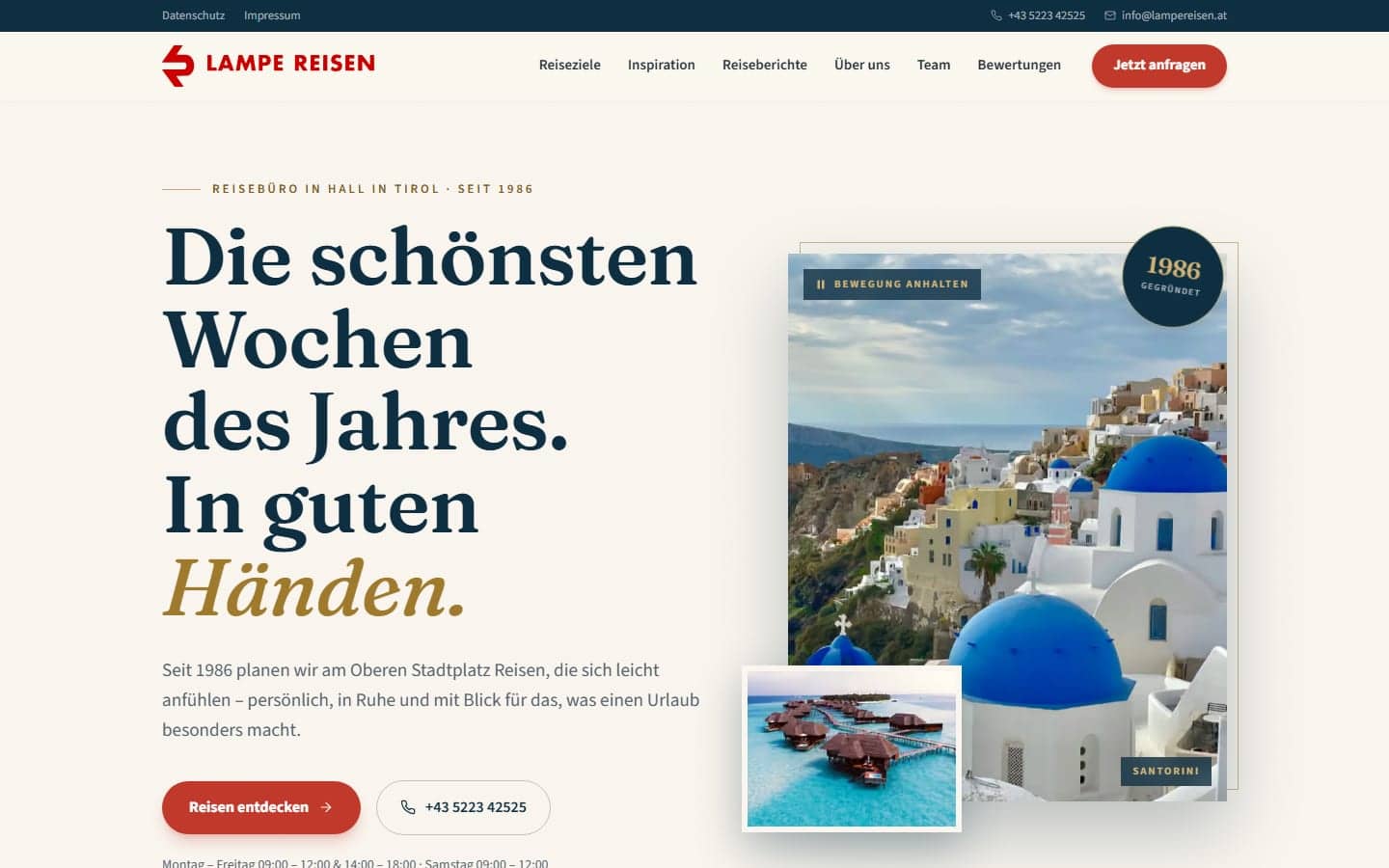
Lampe Reisen is a travel agency on the Oberer Stadtplatz in Hall in Tirol, founded in 1986: a small team that has travelled its destinations itself and advises in person, from package holidays to long-haul trips. The old website showed little of that. Who on the team knows which destination was something you only learned in the shop.
The second construction site was the back office: supplier invoices arrived by email, were printed and matched to bookings by hand, even though the travel agency software could handle much of it automatically.
Watch first, then automate.
Two tasks, one principle: don’t replace what works. The website should show the agency as it is. In the back office the travel agency software remains the leading system; the goal is to use it better, not to replace it.
For the back office we didn’t run interviews, we watched: a morning on site at the workstation, every step recorded. Only then did it become clear why the team deliberately bypasses the automation, and that is exactly where the leverage lies.
Editorial website on Next.js
A lead story with rotating destinations, reading columns and travel ideas with their own image galleries. Rating and quotes come straight from the Google profile.
Team atlas with a globe
The destinations the team has travelled itself, shown as points on a rotating globe with Hall in Tirol as the starting point. Choose an advisor and arcs lead to their places; tap a place and destination and contact person go straight into the inquiry. Without WebGL the list remains, and it holds everything.
Inspiration page
Twelve destinations to scroll through, from the Maldives to New York: one chapter per destination with a full-screen image, the person on the team who has been there, and a direct path to an inquiry.
Technical foundation
Structured data, sitemap, clean canonicals and 11 redirects from old URLs so existing search results don’t lead nowhere. Lighthouse mobile, old site against new: accessibility 87 → 100, best practices 71 → 100, SEO 92 → 100.
Readable for AI search
A machine-readable description of the agency (Schema.org with location, opening hours and the current offer), an llms.txt with services, team destinations and contact details, and AI search services such as ChatGPT, Claude and Perplexity explicitly allowed in robots.txt. What answer engines say about the agency is available in a form they can read directly.
Privacy and security
Analytics only after consent (no request goes to Google without it), server functions in Frankfurt, security headers with a strict content security policy, legal notice worded exactly as in the trade register.
An inquiry in three steps
Three short steps instead of a long form, protection against mass spam submissions and a fallback that sends even without JavaScript.
Invoice workflow: assessment and staged plan
System map of the travel agency software, root cause of the manual work identified, interface to the tax advisor’s accounting checked. The result is a staged plan: PDF instead of printouts and the order number in the file name first, the connection to accounting later.
- A website that shows what makes the agency special: people who know their destinations first-hand, from the globe to the inspiration page.
- On mobile the main content appears after 3.1 instead of 5.6 seconds (Lighthouse, simulated mobile connection), accessible, technically clean for search engines, privacy-compliant from the first visit.
- Location, services and offer are machine-readable, for classic search as well as for AI answer services.
- No break during the move: old URLs lead to the matching new page.
- In the back office the cause of the manual work is identified, along with a way to reduce it step by step without touching the booking system.
The most important insight didn’t come from a workshop but from watching at the workstation. What looked like missing digitization from the outside was a deliberate decision by the team: the automation is bypassed because at one point it leaves too little control. Miss that, and you automate right past the problem.
Travel agencies and service providers with an outgrown website and a lot of manual work between industry software and accounting.

Facing a similar challenge?
Tell us what's still running manually — we'll get back to you within 24 hours on business days with a clear answer.
Axel Mühlbacher · Managing Director